When Back Pain Isn’t Getting Better: What Should Happen Next?
Back pain does not always follow a linear recovery pathway.
For those with chronic primary low back pain, the World Health Organisation recommends person-centred care that considers the physical, psychological and social factors that may be contributing to the pain experience, with a combination of interventions often needed rather than a single treatment (World Health Organisation, 2023)
For some people, the usual pathway of seeing a GP, trying physiotherapy, having a scan or receiving treatment works well. For others, they may improve for a while, only for the pain to return, or complete treatment without making the progress they had hoped for.
So when that progress stalls, the question becomes: what still needs to be understood?
At Back, Neck and Joint (BNJ), we look at the clinical questions that need to be answered next: where the pain may be coming from, whether that needs to be tested further, how pain can be managed, how function can be restored, or why the patient is not progressing.
Our clinicians share expertise in musculoskeletal pain, but each brings additional skills and different ways of thinking about these questions.
Back Pain Diagnosis: Identifying and Testing the Likely Pain Source
One of the first questions is where the pain may be coming from.
For lower back pain, Dr Dan’s approach considers five main potential pain generators: the facet joints, sacroiliac joints, hips, discs and nerves. The challenge is that their referral patterns can overlap, so pain location provides a direction, but does not necessarily provide the diagnosis.
Dr Dan Bates uses his low back pain algorithm to provide a structure for working through these presentations. History, pain pattern and examination establish a working direction, with imaging considered in that context. In a systematic review, people without pain found that degenerative findings on spinal imaging were common, and it increased with age (Brinjikji et al., 2015). This is important because the five structures have overlapping referral patterns, and imaging findings can also occur in people without pain.

Dr Dan Bates of Back, Neck & Joint
When the suspected source remains uncertain, diagnostic procedures can test the hypothesis. For suspected facet joint pain, a medial branch block temporarily blocks the nerve supply to the joint. A positive response makes facet pain more likely, while a second positive block increases diagnostic certainty.
This is where Dr Dan’s additional interventional skill set can become useful. Alongside working through the potential pain generators, Dan brings X-ray and CT-guided procedural skills, including the ability to perform procedures under sedation.
For patients who are highly sensitised or may have difficulty tolerating a procedure, sedation can provide an option for working through the diagnostic and therapeutic process more comfortably.
When Back Pain May Be Coming from Somewhere Else
“Where pain is felt does not always tell us which structure is responsible.” For example, hip pathology can be part of a back pain presentation.
But identifying the pain source may be only one part of understanding why a patient isn’t progressing.
In this instance, Dr Zee Arain adds experience across General Practice, Sports Medicine and intervention, where his approach to back pain involves looking at the history and examination alongside investigations to determine whether another structure, such as the hip, could be contributing to the symptoms. Where the source remains uncertain, a diagnostic injection may sometimes provide additional information.
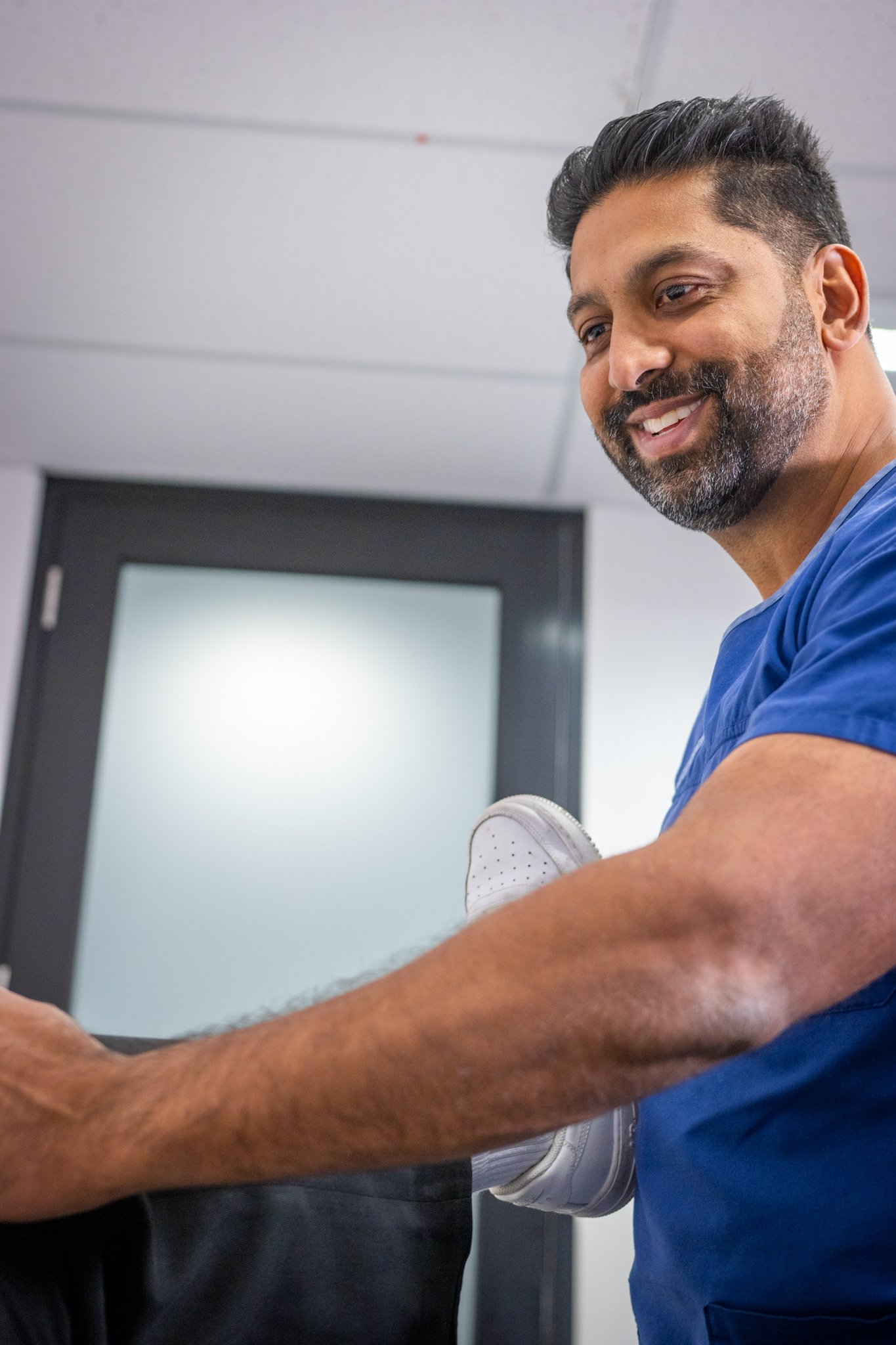
Dr Zee Arain consulting with a patient about knee pain
Similarly, Zee brings additional training and interest in diet and nutrition. For some patients, dietary, nutritional or metabolic factors can form part of the musculoskeletal presentation, which helps us understand more about what may be contributing to their ongoing pain.
This broader generalist perspective provides another way of looking at back pain, when the existing explanation does not fully explain why a patient is still in pain.
When Pain Is Obstructing Rehabilitation
Finding a likely pain source is only part of the process. The next challenge may be getting the patient moving again.
Dr Ömer Batin Gözübüyük approaches musculoskeletal pain from a Sports and Exercise Medicine perspective, with exercise therapy forming the basis of treatment for most musculoskeletal conditions in his practice.
Ömer also brings additional expertise in musculoskeletal ultrasound. This provides another way of investigating structures that may not be as clearly assessed using X-ray or CT, as well as allowing ultrasound-guided diagnostic and interventional procedures where appropriate.
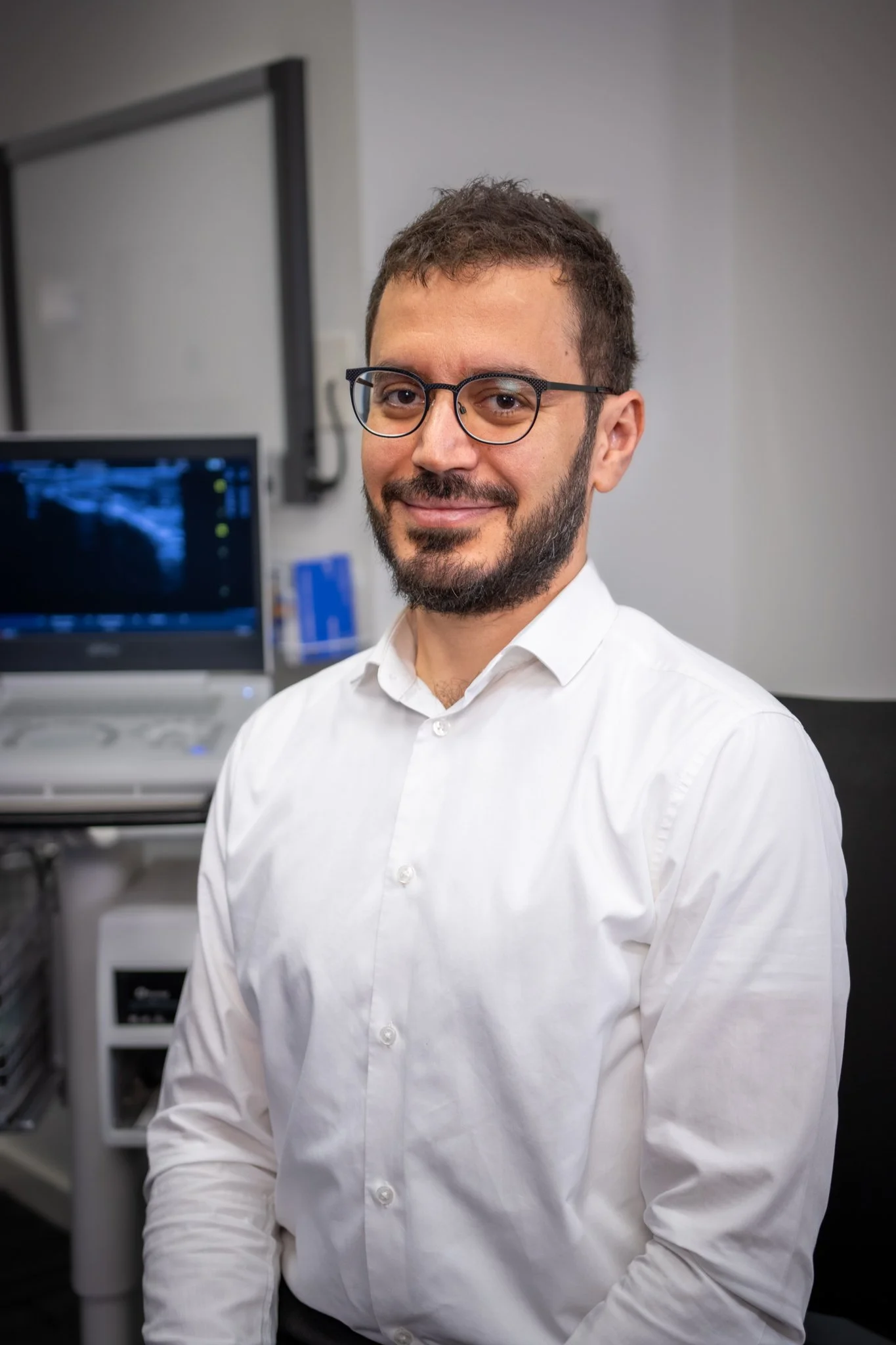
Dr Ömer Batin Gözübüyük performing an ultrasound-guided assessment
This additional skill set provides the BNJ team another way to investigate and treat a musculoskeletal presentation when a patient isn’t progressing as expected.
When an intervention is considered, the question becomes where it fits within the patient’s broader management. It may contribute to understanding the problem, managing symptoms or helping rehabilitation progress.
This makes the patient’s functional progress part of the decision-making process: what is preventing them from moving forward, and what role could treatment play in helping rehabilitation progress?
Dan’s 5 minute low back +/- leg pain algorithm follows a similar principle. Interventions may be considered when pain severity is creating a barrier to physical reconditioning or other rehabilitation.
When Back Pain Becomes More Complex
Persistent back pain can often become complex when several factors are contributing at the same time.
Research into chronic low back pain found that multidisciplinary biopsychosocial rehabilitation can improve pain and disability, compared with usual care, which supports a broader approach when there is a complex presentation (Kamper et al., 2014)
When a patient is not progressing, Dan considers the response to rehabilitation: are they getting better during rehabilitation but not improving long term, getting worse, or staying the same?
These patterns change the clinical question. Improvement without longer-term progress raises questions around continuing the exercises. Worsening can lead Dan to consider sensitisation, joint dysfunction or another diagnosis. No change raises the question of whether the right problem is being treated.
This is where broader diagnostic experience can become particularly useful.
Dr Jason Lam brings a General Practice background alongside further specialist training in Sport and Exercise Medicine, with particular experience working with complex patients.

Dr Jason Lam of Back, Neck & Joint.
His interests include diagnostic challenges, pain, chronic illness and hypermobility. This broader perspective can be useful when a patient has already been through the expected investigations and rehabilitation but the existing explanation still does not account for what is happening.
For these more complex presentations, Jason brings another way of looking at the clinical picture and considering whether a less obvious diagnosis or combination of factors may need to be explored.
Choosing the Right Approach to Treating Back Pain
While there is an overlap in how our clinicians think about and manage musculoskeletal pain, the difference is in the additional expertise each clinician brings when a patient’s pain is stuck.
Dan brings X-ray and CT guidance, with the ability to perform sedated procedures. Zee brings a generalist approach with expertise in musculoskeletal medicine and intervention, alongside additional training in diet and nutrition. Ömer brings specialist expertise with additional ultrasound skills and diagnostic and interventional approaches. While Jason brings a generalist approach with a subspecialty in Sports Medicine and particular expertise in managing complex patients.
Having that range of expertise is important, particularly because there are different reasons why someone with back pain may not get better as expected.
Sometimes there may be an untreated underlying diagnosis. Other times, there could be external factors contributing to the presentation. Or sometimes the answer isn’t clear yet.
At BNJ, being able to say “we don’t know yet” is part of that process. The next question is what can be done to understand more.
Sometimes the answer may take time. What happens next depends on what the patient’s presentation is telling us, what still needs to be understood, and how different expertise within BNJ can help us keep working through the pain with them, aiming to help them move forward and get back to the things that matter most to them.
At BNJ, our role is to work through those questions carefully by clarifying the likely pain source, considering further investigation, supporting rehabilitation and/ or looking more broadly at a complex presentation.
For patients:
If your back pain isn’t improving as expected, you can book an appointment with the BNJ team.
For GPs and allied health professionals:
If you’re managing a patient whose back pain is not progressing as expected, you can refer them to BNJ or contact our team at admin@backneckandjoint.com.au to discuss the appropriate next step.